


· By Shopify API
Local Nutrition Magnesium Blog
How Much Magnesium Should I Take Per Day?
Why Most Magnesium Labels on Amazon & in Stores Are Deceiving Customers
So you decided to start taking magnesium.
Great!
Then you turn the bottle around and see:
100 mg.
200 mg.
400 mg.
500 mg.
So... how much magnesium should you actually take per day?
For adults, recommended magnesium intake is generally 310 to 420 mg per day, depending on age, sex, size, and physical activity.
Adult women generally need 310–320 mg per day.
Adult men generally need 400–420 mg per day.
And the FDA Daily Value used on supplement labels is 420 mg.
That makes one thing very clear:
Dosage matters.
If you are taking magnesium because you want to meaningfully support your daily magnesium intake, you should know how much you are actually getting.
Because the number on the front of the bottle does not always tell the whole story.

Well Over Half of Americans Fall Short on Magnesium From Food
Before talking about supplements, there is another number worth knowing.
Over 48% of Americans consume less magnesium from food and beverages than their Estimated Average Requirement.
That comes from an analysis of U.S. NHANES dietary data cited by the National Institutes of Health.
Think about what that means.
Magnesium is found in foods like leafy greens, nuts, seeds, beans, and whole grains.
But modern diets do not always contain enough of those foods every day.
Food processing can also reduce magnesium.
The NIH notes that refining grains removes the nutrient-rich germ and bran and can substantially lower their magnesium content.
Then add modern life.
Long workdays.
Stress.
Coffee and increased caffeine consumption.
Poor sleep.
Rushing from one responsibility to another.
Research has described a two-way relationship between magnesium and stress.
Stress may increase magnesium loss, while lower magnesium status may make the body more vulnerable to stress.
Even caffeine can matter.
In a controlled human study, caffeine increased magnesium loss in urine over 24 hours.
So if your diet is already coming up short, a tiny sprinkle of magnesium in a supplement may not do much to close that nutritional gap.

Is 100 or 200 mg of Magnesium Enough?
Here is a simple way to look at it.
The FDA Daily Value for magnesium is 420 mg.
Which means that you need at least 420mg daily to meet your body's magnesium needs.
Many experts in 2026 believe this is on the low end as well due to modern habits and lifestyles.
Here is an easy way to look at elemental (absorbable) magnesium intake:
Elemental Magnesium:
100mg - 24% of your needed daily magnesium
200mg - 48% of your needed daily magnesium
300mg - 67% of your needed daily magnesium
420mg - 100% of your needed daily magnesium
There is no magic line where 199 mg suddenly does nothing and 200 mg suddenly works.
Your food intake matters.
Your age matters.
Your individual habits matter.
But the math still matters too.
If your goal is to fill a meaningful magnesium gap, a product providing only 100 mg gives you less than one-quarter of the Daily Value.
That may be enough to top off an already magnesium-rich diet.
But if you are not consistently eating pumpkin seeds, spinach, beans, almonds, whole grains, and other magnesium-rich foods every day, it may leave a much larger gap untouched.
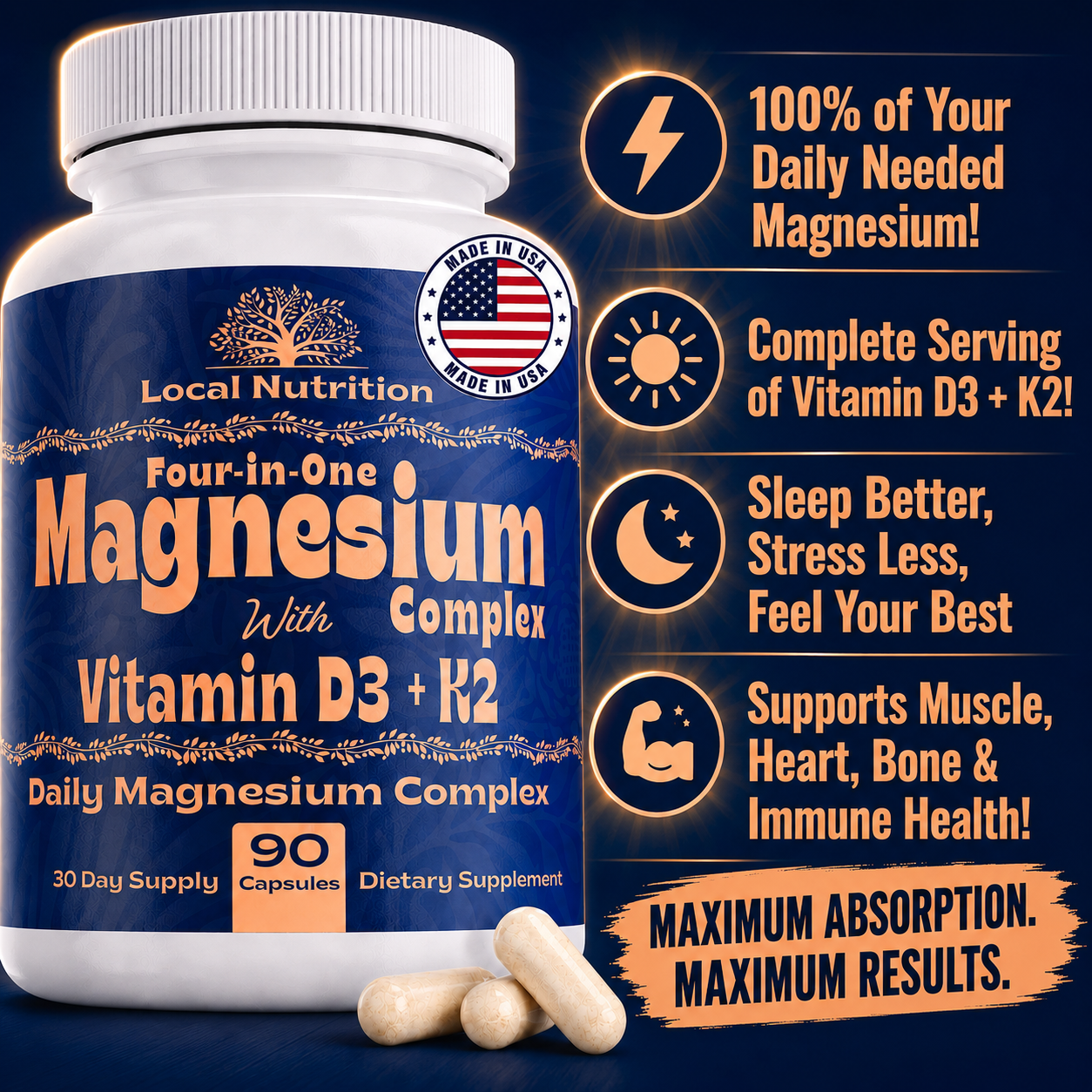
That is why we built Local Nutrition Daily Magnesium around a full serving of:
420 mg of Elemental Magnesium
Three capsules provide 100% of the Daily Value.
But we intentionally made that amount flexible.
If you want the full serving:
3 capsules = 420 mg
If you prefer less:
2 capsules = 280 mg
If you want an even smaller amount:
1 capsule = 140 mg
So instead of buying a low-dose product and being stuck there, you can adjust your intake based on your diet, routine, and personal tolerance.

The Biggest Magnesium Label Mistake
There is another mistake that can completely change how you compare magnesium supplements.
You need to look at elemental magnesium.
This is the amount of magnesium that is actually absorbed, not the raw powder amount.
Not just the giant number printed on the front of the bottle.
For example, a bottle might advertise a large amount of "Magnesium Glycinate Complex."
That number can refer to the weight of the entire magnesium compound.
But only part of that compound is absorbable magnesium.
The NIH confirms that the Supplement Facts panel lists the amount of elemental magnesium, not the total weight of the magnesium-containing compound.
That is the number that counts toward your daily magnesium intake.
So when comparing bottles, turn them around.
Find:
Magnesium — ___ mg
That is one of the most important numbers on the entire label.
Also be very wary of companies that do not list how much of each type of magnesium is in the product.
They pray on customers by hiding these amount in proprietary or mystery blends made of mostly cheap magnesium oxide!
Dosage Is Only Half the Story. The Form Matters Too.
Imagine two supplements.
Both say they provide 400 mg of magnesium.
Are they equal?
Not necessarily.
Different forms of magnesium dissolve and absorb differently.
And this is where inexpensive magnesium oxide becomes important.
Magnesium Oxide: Big Number, Poorer Absorption
Magnesium oxide is common in most magnesium supplements.
One reason it can look attractive on a label is that it contains a high percentage of magnesium by weight.
But your body still has to absorb it.
The NIH reports that more soluble forms of magnesium tend to be absorbed better than magnesium oxide.
A 2025 review of magnesium bioavailability reached the same conclusion: magnesium bisglycinate and magnesium chloride showed good bioavailability, while magnesium oxide was poorly bioavailable, partly because of its low water solubility.
An earlier randomized, double-blind study also found magnesium oxide performed no better than placebo on several measures of magnesium status, while more soluble forms produced stronger changes.
So a large magnesium number alone is not enough.
You want to know:
How much elemental magnesium am I getting?
And:
What forms provide it?

Why Daily Magnesium Uses Four Forms
We built Daily Magnesium with:
Magnesium Bisglycinate
Magnesium Malate
Magnesium Taurate
Magnesium Chloride
Rather than relying on magnesium oxide to inflate the magnesium content, the formula combines four intentionally selected forms.
And the magnesium amount is fully disclosed:
420 mg elemental magnesium per 3-capsule serving.
Magnesium chloride is specifically listed by the NIH among the forms that tend to have higher bioavailability than magnesium oxide.
The formula also includes Vitamin D3 plus both MK-4 and MK-7 forms of Vitamin K2, giving you broader foundational nutritional support in the same daily routine.
No proprietary blend.
No magnesium oxide.
No magnesium citrate.
Double third-party lab tested.
Made in the USA.
Why We Prefer a Full-Strength Formula With a Flexible Serving
There is a simple reason.
You can always take less of a full-strength formula.
You cannot take more magnesium out of a capsule that was never there.
Someone eating a magnesium-rich diet may decide that two capsules fit their routine.
That provides 280 mg of elemental magnesium.
Someone looking for the full Daily Value can use the complete three-capsule serving.
That provides 420 mg.
You can also split the capsules throughout your day instead of taking everything at once.
This is actually recommended by health experts as well.
Spreading magnesium intake throughout the day instead of all at once, increases the amount absorbed and the benefits!
That flexibility is one of the advantages of building the full serving across three capsules.
The formula meets you where you are.

Do Not Waste Money on a Magnesium Label You Haven't Read
Before buying your next magnesium supplement, check three things:
1. How much elemental magnesium does it provide?
2. What forms of magnesium does it use?
3. Is the formula transparent and tested?
Those three questions can tell you much more than the giant number on the front of the bottle.
Daily Magnesium was built to make those answers easy.
420 mg elemental magnesium.
Four magnesium forms.
Vitamin D3 + K2.
No oxide or citrate.
No proprietary blends.
Double third-party lab tested.
And if you want to try it for yourself, you can currently get 50% off your first Subscribe & Save order on Amazon.com.
Compare the label.
Compare the dose.
Then decide what makes the most sense for your daily routine.
Feel like yourself again with Local Nutrition!
We would love for you to join the family!
We are a small family owned business that puts customers first!
No A.I. customer service, only real humans who care about your wellbeing and satisfaction.
Hurry! For a Limited Time
Save Big on Amazon.com Today!
Get 50% Off + FREE eBook and More!
Save 50% on Your First Amazon Purchase
FREE eBook: Get the Best Sleep of Your Life
FREE Supplement Buying Guide
Weekly Health Tips Delivered Directly to Your Inbox

Simply Click Grab My Deal and Enter your email to receive your
Coupon, eBook, + Buying Guide
Get My Deal